






The question of whether you need a registered agent is one of the most fundamental queries for any business owner. In the United States, the answer is an emphatic yes for nearly every legal business entity. Whether you are an LLC, a corporation, or a partnership, state statutes mandate the appointment of a registered agent to ensure the government has a reliable method of communicating with your firm. This role is not merely a formality; it is the linchpin of your regulatory compliance and legal standing.
Selecting the right registered agent is a foundational decision that impacts the long-term legal standing of your business entity. Every U.S. business, whether an LLC, corporation, or partnership must maintain a reliable point of contact to receive service of process, government correspondence, and critical legal notifications. Choosing the best provider helps avoid administrative pitfalls, such as missed deadlines, default judgments, or administrative dissolution.
The Legal Requirement for Representation
Every state in the US requires businesses to maintain a registered agent within the jurisdiction of formation and any state where they are qualified to do business. This requirement is rooted in the concept of due process. The state government, courts, and federal agencies must have a guaranteed, physical point of contact to deliver legal process, official notices, and tax documentation.
If you are planning to start a business, this appointment is usually the first action taken during the filing process. Without an agent, your business cannot be effectively served with lawsuits or legal summons. The consequence of neglecting this requirement is severe. Businesses that do not maintain an agent often face administrative dissolution, which means the state strips the entity of its right to operate. This dissolution effectively ends with the limited liability protection of your company, exposing your personal assets to business debts and legal judgments.
Why Self Representation Is Rarely Recommended
Many entrepreneurs, especially those in the early stages, are tempted to serve as their own registered agent to minimize costs. While this is legally permitted in many states, it is a risky operational choice. When you act as your own agent, you are publicly declaring your availability to accept legal documents at your address of record.
The primary issue with self representation is the lack of professional boundaries. Legal documents often involve private lawsuits or urgent government notices. If you are serving as your own agent, these documents will be delivered to you directly, regardless of your location, time of day, or your ability to process them. This creates a significant privacy risk because the address of the registered agent is a matter of public records. For home based entrepreneurs, this means your home address becomes a public listing, inviting unwanted solicitation and privacy concerns.
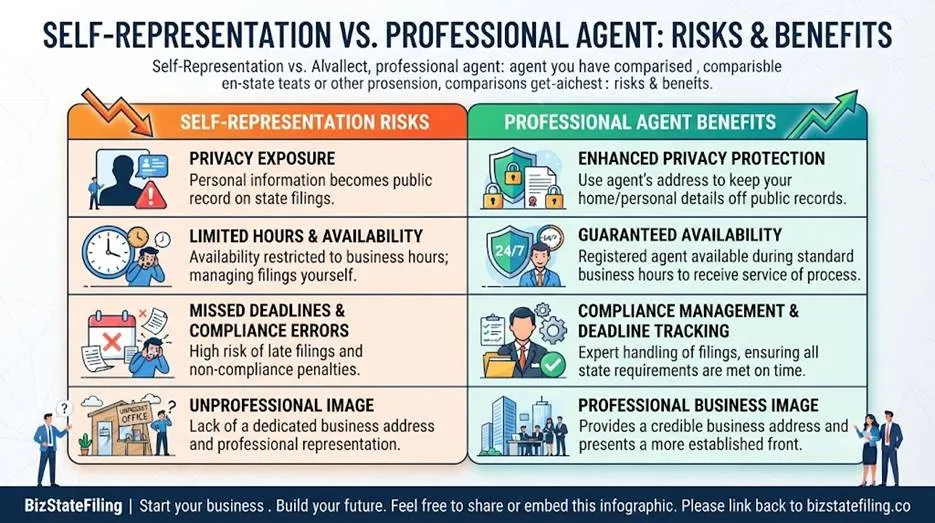
Beyond privacy, self representation fails when you move or take vacations. The state requires a registered agent to be available during standard business hours. If you are away from your designated address, you risk missing critical legal filings. A missed deadline can result in a default judgment against your company, which can be far more costly than the fee paid for a professional service.
|
Feature |
Self Representation |
Professional Registered Agent |
|
Availability |
Limited by personal schedule |
Guaranteed standard business hours |
|
Address Privacy |
Personal address becomes public |
Professional office address used |
|
Document Handling |
Manual receipt and potential risk |
Secure digital receipt and archive |
|
Reliability |
Dependent on human presence |
Always available for process servers |
|
Multi State Scaling |
Extremely difficult |
Seamless across multiple states |
|
Audit Trail |
None or manual |
Comprehensive digital history |
Evaluating the Operational Load
Compliance is often treated as an administrative nuisance, but it is actually a core component of risk management. When you use a professional service, you are offloading a critical business function to an entity designed to track state specific deadlines. This allows you to focus your attention on your actual operations rather than monitoring state statutes.
For leaders who struggle with administrative overhead, finding ways to streamline tasks is vital. Some executives use a time blocker tool to ensure that administrative reviews are not skipped. However, no amount of scheduling can replace the utility of a professional agent who is physically present and available at a designated office address every single business day.
When you look at the complexities of business formation, you quickly realize that compliance is not a static state; it is a dynamic requirement that changes as your business expands. If you are managing multiple entities, keeping track of different registration requirements, annual report dates, and notice of service deadlines becomes an unsustainable full time task.
Financial Risk and Compliance Costs
The cost of a registered agent service is a small, predictable annual expense. In contrast, the financial risks of noncompliance are unpredictable and potentially ruinous. When you calculate business break even point, you should always treat compliance as a necessary operational cost, not an avoidable luxury.
A default judgment resulting from a failed service of process can result in the loss of assets, frozen accounts, and long term litigation costs that dwarf the lifetime expense of a professional service. Additionally, if you are preparing to buy a business, one of the first elements a buyer or their attorney will investigate is the target company compliance history. A history of missed filings or lack of a registered agent is a massive red flag that can destroy a valuation or derail a deal entirely.
|
Risk Category |
Consequence of Failure |
Financial Impact Level |
|
Legal Process |
Default court judgment |
High to Extreme |
|
State Filing |
Administrative dissolution |
Moderate to High |
|
Privacy |
Public address exposure |
Incalculable |
|
Operational |
Missed tax notices |
Moderate |
|
Reputation |
Loss of good standing |
Variable |
Strategic Advantages of Professional Services
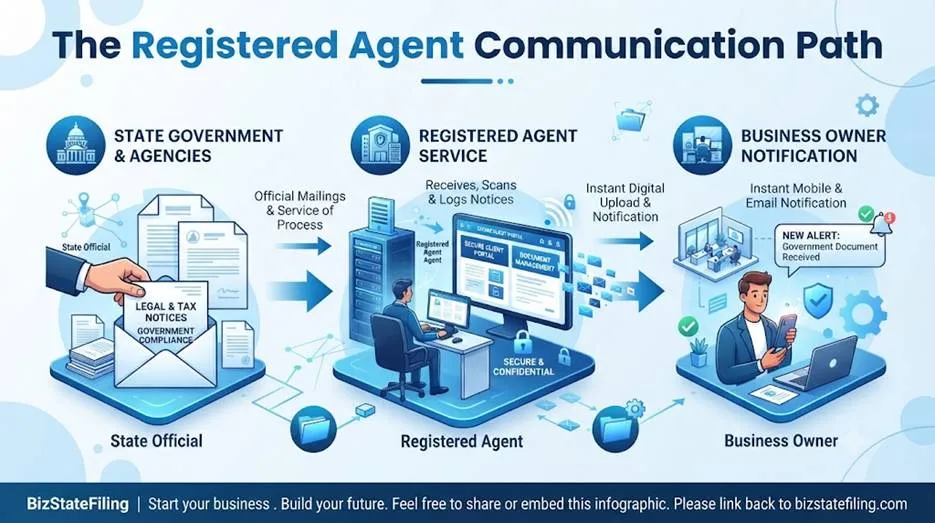
Professional registered agents offer more than just a street address. They provide a digital architecture for your compliance needs. The best providers utilize secure, encrypted portals to receive, scan, and store your legal documents. This transforms the receipt of a lawsuit or a tax audit notice from a potential crisis into a managed business event.
This digital integration is essential when you consider how your business matures. As you start to buy a business, you need a centralized repository for all legal documents across all your entities. Professional agents act as this hub, providing an audit trail that is critical during mergers, acquisitions, or even simple banking applications.
Furthermore, these services often provide proactive notifications for annual reports and franchise tax deadlines. By relying on a professional, you are essentially buying peace of mind and the assurance that you will not lose your good standing due to a clerical error.

The Role of Privacy and Data Protection
We live in an era where data security is a top tier business priority. When you list your personal address as the registered agent address, you are effectively giving the public a way to track your physical location. Professional agents use their own office addresses, providing a necessary buffer between your private life and public records.
Protecting sensitive business information is a major concern. Even before a document reaches your agent, you should be proactive. Some business owners use a text redactor to sanitize internal documents before they are uploaded or shared. While your registered agent handles the official legal notice, ensuring your internal hygiene matches the security offered by your professional partners creates a culture of safety.
Scalability and Multi State Expansion
If you are a local entrepreneur, you might think you only need a registered agent in your home state. However, as you scale, you will likely need to register as a foreign entity in other states where you generate revenue or have a significant physical presence.
Scaling into new jurisdictions requires you to appoint a registered agent in every one of those states. Attempting to manage this internally is nearly impossible. A national professional service provides a single point of contact and a unified dashboard for all your multi state compliance. If you are researching where to expand, it is helpful to look at best cities for business and then cross reference those with your agent provider network.
|
Expansion Phase |
Compliance Complexity |
Registered Agent Necessity |
|
Startup |
Localized filing |
Essential for formation |
|
Regional |
Multi county compliance |
Vital for privacy |
|
National |
Foreign qualification |
Required in every state |
|
International |
Complex treaty status |
Necessary for local entity |
|
Exit/Sale |
Audit and good standing |
Critical for valuation |
Industry Specific Compliance Needs
Certain industries face higher levels of regulation, and the role of the registered agent becomes even more critical in these sectors. For instance, companies operating in the health and senior care field are subject to intense scrutiny regarding patient records, safety protocols, and licensing. Failing to receive a regulatory notice in this industry can lead to immediate revocation of a license.
Similarly, companies in financial services or construction must adhere to strict state level reporting requirements. Your registered agent should be familiar with the nuances of your industry. If you are working in a highly regulated space, choose a provider that understands the volume and type of correspondence you are likely to receive.
Using relocation intelligence to choose your operational base is a smart move, but once you are established, your registered agent ensures that your good standing remains intact regardless of the regulatory environment. They are your first line of defense in maintaining the health of your legal entity.
Managing the Human Element of Compliance
Even with the best tools, you still need to ensure that the documents your agent receives are processed correctly by your team. Many owners are guilty of compliance apathy, where they set up the registered agent and then forget about it until a problem occurs. This is a dangerous mindset.
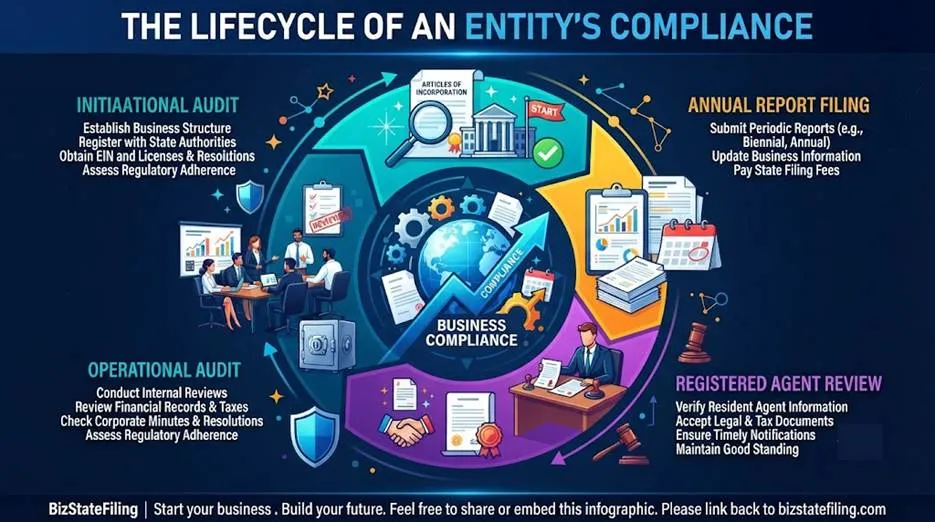
You should conduct a formal annual review of your entity status. Use business growth metrics to keep track of how many jurisdictions you operate in and ensure your agent is active in all of them. Consistency is the goal. When you integrate your agent's updates into your yearly audit, you prevent the accumulation of administrative debt.
If you are currently confused by the process, consulting a franchise guide or similar resources can help you understand how different business models impact your legal requirements. The key is to never treat compliance as an afterthought.
|
Audit Phase |
Focus Area |
Action Required |
|
Initial Formation |
Registered agent appointment |
Confirm physical availability |
|
Quarterly Review |
Document reception history |
Verify portal access |
|
Annual Audit |
Compliance good standing |
Review state filings |
|
Growth Phase |
Expansion into new states |
Appoint additional agents |
|
Exit Strategy |
Compliance history verification |
Compile full documentation |
Evaluating Your Provider
Not all registered agent services are equal. When evaluating a potential partner, look for transparency in pricing and technical capability. Avoid providers that hide fees or fail to provide a digital portal. You want a provider that is transparent about their service levels and offers a robust system for document delivery.
If you are unsure of your status, you can always visit the FAQs of your state government website or your provider to learn more about changing your agent. It is a straightforward process, and upgrading to a more reliable service can be done at any time.
Conclusion
Do you need a registered agent? If you want to legally operate an entity, protect your privacy, and ensure that your business receives important legal notices without fail; the answer is a definitive yes. It is one of the most cost effective investments you can make in the long term viability of your business. By shifting the burden of legal notice receipt to a professional, you are not just checking out a box; you are building a foundation of operational security that will serve you throughout the lifetime of your company.
Frequently Asked Questions
1. Is a registered agent legally required?
Yes, every US state requires LLCs and corporations to maintain a registered agent to ensure there is an official point of contact for legal and government notices.
2. Can I be my own registered agent?
In most states, you can act as your own agent if you have a physical address in the state and are available during business hours, but it is generally discouraged due to privacy risks.
3. What is the primary purpose of a registered agent?
The primary purpose is to receive service of process and official state correspondence on behalf of your business, ensuring you stay in compliance with state laws.
4. Does a registered agent protect my privacy?
Yes, professional services allow you to use their business address for public filings instead of your personal or home address.
5. What happens if I do not have a registered agent?
Your business will likely fall out of good standing, which can lead to administrative dissolution, loss of your liability protection, and fines.
6. Is a registered agent the same as a lawyer?
No, a registered agent only receives legal documents; they do not provide legal advice or represent you in court.
7. Can I change my registered agent?
Yes, you can change your agent at any time by filing a Change of Registered Agent form with the Secretary of State in your jurisdiction.
8. How does a registered agent affect business valuation?
Investors perform due diligence on your compliance history. Having a properly managed, consistent registered agent record shows that you manage your regulatory obligations professionally.
9. Are the fees for a registered agent tax deductible?
In most instances, the fee for a registered agent is considered a necessary business expense and is tax deductible for your entity.
10. What is the service of the process?
Service of process is the legal procedure where a party to a lawsuit gives appropriate notice of the legal action to another party, typically handled by the registered agent.
 Perplexity
 Claude
 Grok
Grok