




The landscape for launching a commercial enterprise in Florida is characterized by its dynamic economic growth and its decentralized regulatory environment. Unlike states that maintain a unified master operating permit, Florida operates through a layered system where requirements are dictated by state, county, and municipal authorities. For any entrepreneur aiming to start a business in USA, understand these jurisdictional layers is the foundation of long-term operational success.
Navigating business licensing in Florida requires understanding that the state does not issue a single, universal general business license, but instead requires various state, county, and municipal permits depending on your industry and location. Business owners must identify specific professional licenses, regulatory permits, and local tax receipts mandated by their city or county authorities to ensure full legal compliance before commencing operations.
The Regulatory Framework of Florida Commerce
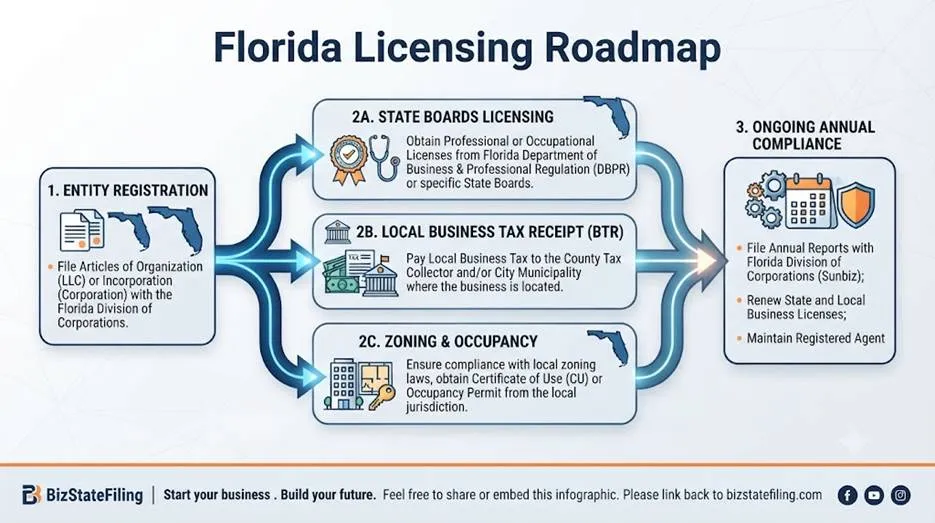
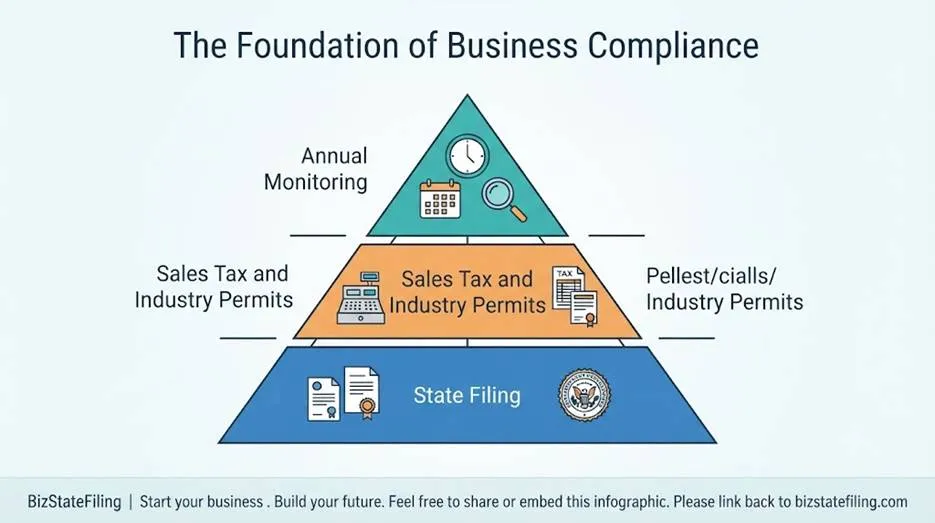
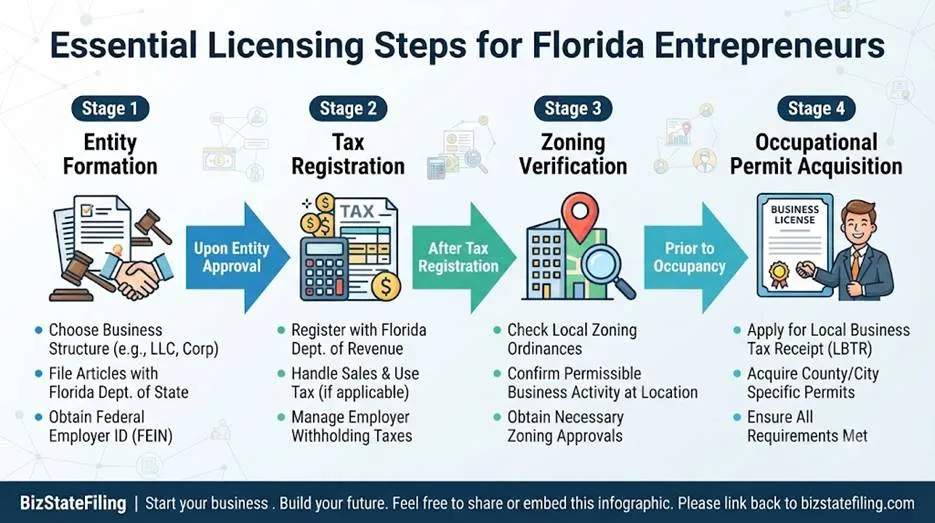
In Florida, the journey to compliance begins after you have formalized your entity with the Department of State. While entity registration grants you the right to exist, it does not inherently grant the right to trade. Most businesses require at least one local permit, and depending on your specific operations, you may find yourself navigating multiple state boards simultaneously.
The complexity of these requirements is often underestimated by new founders. A business operating out of a professional office space in Miami faces different regulatory hurdles than a home-based digital service provider in Jacksonville. To manage this effectively, many founders utilize a professional business registration platform to track their filing dates and license expiration cycles. Without a centralized system, it is far too easy to overlook a critical renewal deadline, which could lead to administrative penalties or forced suspension of services.
Analyzing Local Market Requirements
Before you finalize your location, you must conduct a thorough small business location analysis. Florida is a diverse state, and local ordinances vary significantly between coastal tourist hubs and inland industrial centers. Municipalities often enforce their own business tax receipts, formerly known as occupational licenses. This document is essentially a permit to conduct business within city limits.
Beyond the business tax receipt, zoning is the most common point of friction. If you are planning to buy an established franchise, you must confirm that the existing location has all the necessary certificates of occupancy. These documents verify that your building meets current fire, safety, and health codes. You may need to use relocation intelligence tools to factor in these potential costs if you have to renovate or upgrade a space to meet municipal code standards.
Industry Classification and Compliance
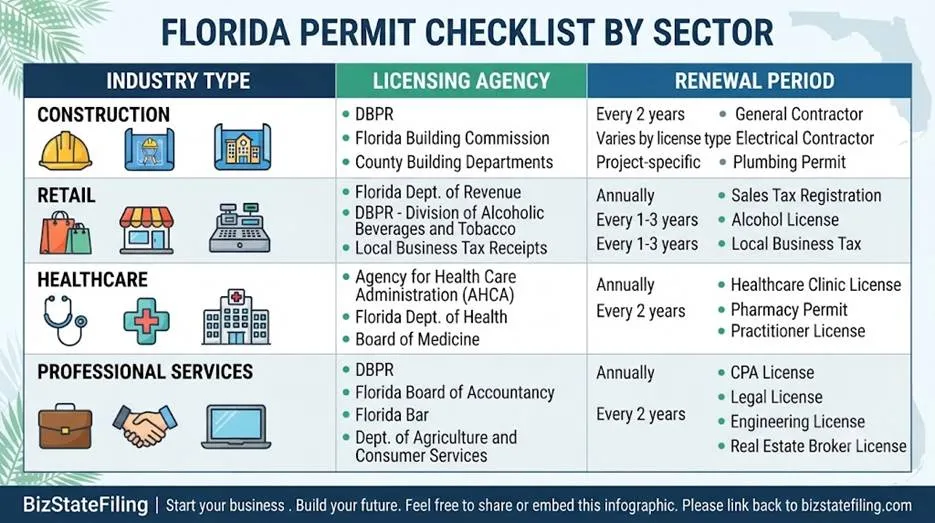
Regulatory oversight in Florida is heavily skewed by your industry. A retail business faces a standard sales tax registration process, while a construction firm must deal with strict state-level board certifications. Below is a breakdown of common regulatory burdens across various sectors.
|
Industry Sector |
Primary Regulatory Agency |
Typical Compliance Frequency |
Core Requirement Focus |
|
Professional Services |
Dept of Business Regulation |
Biennial |
Technical competency |
|
Construction and Trades |
Construction Industry Board |
Annual |
Safety and liability |
|
Retail and E-commerce |
Dept of Revenue |
Permanent |
Sales tax collection |
|
Hospitality and Tourism |
Dept of Business Regulation |
Annual |
Sanitation and safety |
|
Healthcare and Clinics |
Agency for Health Care |
Annual |
Patient welfare |
|
Real Estate Brokerage |
Real Estate Commission |
Biennial |
Fiduciary standards |
|
Child Care Services |
Dept of Children and Families |
Annual |
Background screening |
|
Cosmetic Services |
Board of Cosmetology |
Biennial |
Sanitation standards |
|
Transportation Services |
Dept of Highway Safety |
Annual |
Commercial permits |
|
Financial Consulting |
Office of Financial Regulation |
Annual |
Fiscal transparency |
Financial Obligations and Operational Costs
Maintenance of your business licenses is an ongoing financial expense. It is a mistake to view these as one-time startup costs. Between state annual reports, local business tax receipts, and industry-specific certifications, the overhead can be substantial. Entrepreneurs often use a subscription analyzer and burn rate tool to keep track of these recurring expenses.
Furthermore, if you are looking to find a business for sale, you must treat the transfer of licenses with extreme caution. A license is rarely automatically transferable. You will likely need to re-apply for many permits under the new ownership entity. This process should be factored into you SDE business valuation guide to ensure you do not overpay for an entity that faces immediate regulatory hurdles.
Data Management and Compliance Hygiene
Compliance is not just about holding paper permits; it is about data integrity. State agencies use the information you provide during registration to send out critical updates, tax alerts, and renewal notices. If your contact information is inaccurate, you risk missing important filings. Using bulk address cleaner ensures that your records are consistent across all government portals.
For businesses that store sensitive data, maintaining compliance also involves privacy standards. If you handle client information or process payments, your internal workflows should be regularly audited. Utilizing text redactor tools helps protect sensitive information from accidental disclosure, which is a major component of modern business security compliance.
Strategies for Expansion and Scaling
As your business grows, your licensing needs will expand. Moving from a single location to a regional operation means you must now comply with the ordinances of every city where you have a footprint. If you are looking to explore franchise opportunities as a way to scale, remember that franchisors often provide a blueprint for compliance.
However, even with a proven model, you are still responsible for the local execution. You might need to calculate business break-even point after accounting for the licensing costs of each new location. A common strategy for efficient management is to designate a specific team member to monitor all upcoming renewals. Using time blocker tools allows you to set recurring alerts for annual permit filings, preventing lapses that could lead to fines.
The Impact of Regional Demographic Shifts
Florida is currently experiencing significant population growth, which is driving demand in the service and retail sectors. If you are performing a metropolitan economic health metric assessment for your next site, prioritize areas where the municipal government is known for efficient business permit processing. Delays in zoning approval or final inspections can be the difference between a successful launch and a capital-intensive stall.
Consider the following table for a high-level overview of annual compliance planning.
|
Compliance Stage |
Key Action Item |
Timing |
Strategic Responsibility |
|
Initial Formation |
File articles of organization |
One-time |
Legal Counsel |
|
Local Business Tax |
Apply for city receipt |
Annual |
Operations Manager |
|
Industry Certification |
Register with state board |
Biennial |
Facility Director |
|
Sales Tax Permit |
Register with Dept Revenue |
Permanent |
Finance Lead |
|
Zoning Compliance |
Confirm occupancy status |
Pre-Lease |
General Counsel |
|
Annual Reporting |
File state report |
Annual |
Registered Agent |
|
Safety Training |
Complete required hours |
Annual |
HR Department |
|
Data Security |
Conduct privacy audit |
Quarterly |
IT Coordinator |
Human Capital and Regulatory Complexity
Operating a workforce in Florida requires compliance with state labor laws and payroll taxes. Whether you have one employee or one hundred, you must register for unemployment and reemployment taxes. Founders often rely on a salary to hourly conversion helper to ensure their payroll processing remains accurate and compliant with the latest state's wage standards.
Beyond basic payroll, some industries require mandatory background checks and fingerprinting for employees. Failing to perform these checks can jeopardize your license to operate in sectors like education, healthcare, or financial services. Always verify the specific requirements for your industry on the official state agency websites.
Navigating Specific Industry Board Requirements
Florida is unique in how it empowers professional boards to regulate industries. If you are entering fields like medical care, specialized construction, or legal services, you are answering a state-appointed board, not just a general business department. These boards often require proof of continuing education credits. If you are a healthcare practitioner, you might need to coordinate with resources like those found on FindCarez to ensure your professional certifications align with the needs of the facilities where you practice.
It is equally important to maintain good standing with these boards. Administrative discipline can be public and can impact your ability to bid on contracts or renew your primary business licenses. Proactive communication with your regulatory board is essential.
Environmental and Public Health Compliance
For businesses that interact with the environment or public health, the permit list grows exponentially. Restaurants, chemical handlers, and manufacturers face rigorous inspection schedules. Compliance in this arena is a continuous activity, not a periodic one. If you are running an assisted living facility, your compliance burden includes rigorous reporting on resident safety. You should consult senior care intelligence to stay abreast of current standards in the senior health sector.
Maintaining a clean record requires high-quality documentation. Ensure that your maintenance logs, safety training certificates, and health inspection results are centralized. When the state inspector arrives, the speed and accuracy of your documentation are direct indicators of your commitment to compliance.
The Role of Business Intermediaries
Many business owners find the regulatory environment so dense that they hire consultants. Intermediaries who specialize in business guides can provide a roadmap, helping you avoid common pitfalls. While this adds to your startup costs, the price of an error—such as an unpermitted operation or a violation of local zoning ordinances—can be far higher.
If you are a serial entrepreneur or are looking to expand, the investment in professional compliance guidance pays itself in avoided fines and accelerated time-to-market. The goal is to reach a state where you are proactively monitoring your compliance status, rather than reacting to notices of violation.
Frequently Asked Questions
1. Is there a single, universal business license in Florida?
No, Florida does not have one master license. You must comply with state, county, and municipal requirements, which vary by industry and location.
2. What is a Business Tax Receipt?
A Business Tax Receipt is a permit required by most Florida cities and counties to conduct business within their jurisdiction.
3. Do I need a professional license for every industry?
Not for every industry, but many professional roles, such as contractors, real estate agents, and medical practitioners, require specialized state-issued certifications.
4. Is it possible to file for an LLC online in Florida?
Yes, you can manage your registration through the Department of State portal or use a turnkey business formation tool to simplify the process.
5. What happens if I miss a license renewal deadline?
Missing a deadline often results in late fees and interest. Persistent failure to comply can lead to the revocation of your authority to operate.
6. How do I check zoning requirements before leasing?
Contact the city or county zoning department where the property is located to ensure your intended business activities are permitted at that address.
7. Do home-based businesses need a license?
Yes, home-based businesses are generally subject to the same local business tax and zoning rules as commercial storefronts, though they may have different specific restrictions.
8. Does a sales tax permit apply to all services?
No, it typically applies to the sale of tangible personal property and certain specified taxable services. Consult with the Florida Department of Revenue.
9. Can a registered agent help with license renewals?
A registered agent is primarily for service of process, but many professional agencies offer ongoing compliance services to track your deadlines.
10. How should I prepare for a regulatory audit?
Maintain a comprehensive, central folder for all your permits, licenses, and filings, and ensure all your contact details are kept up to date.
 Perplexity
 Claude
 Grok
Grok